professionals
Teams led across India & France
Engineering consulting · EPC/EPCM · Renewable infrastructure
EPC/EPCM, Renewable Infrastructure and AI-Enabled PMO
Portfolio governance, cross-border delivery, business growth and advisory
I connect technical execution, program governance and people leadership to make complex engineering delivery more predictable—across multidisciplinary, cross-border and asset-intensive environments.
Teams led across India & France
Annual business acquisition supported
Annual business acquisition supported in current role

Bangalore, IndiaEngineering leadership · Organizational performance
01 / Experience & impact
Current role: Associate General Manager · Engineering & Program Leadership
I work where technical depth, delivery pressure and people leadership intersect—turning multidisciplinary complexity into accountable execution.
Teams led across India & France
Annual business acquisition supported
Annual business acquisition supported in current role
Portfolio responsibility
Led and developed multidisciplinary teams of up to 150 professionals across India and France, aligning capacity, interfaces, priorities and management visibility.
Supported annual business acquisition of ₹80–100+ crore in a previous leadership role and ₹20+ crore in the current role.
Directed portfolio responsibility above ₹35–40 crore while connecting engineering progress, resource capacity and management decisions to protect delivery and commercial outcomes.
Combined technical credibility, disciplined governance and key-account ownership to support 90%+ repeat business and sustainable delivery margins.
Integrated engineering
02 / Major projects & systems
Representative work across engineering programs and management systems. Client-sensitive values and identities remain confidential.
Cross-border program leadership
Coordinated multidisciplinary delivery across teams in India and France, aligning resources, technical interfaces, priorities and management visibility. The leadership model combined clear controls with accountable autonomy so specialist teams could act quickly without weakening quality or governance.
Energy & infrastructure
Engineering leadership across power, nuclear and renewable-energy contexts, with emphasis on multidisciplinary interfaces, constructability, technical assurance and delivery governance.
Process & regulated industries
Cross-functional program leadership in technically demanding environments where safety, quality, change control and coordinated engineering are central to successful execution.
Engineering transformation
A published framework case study connecting project data, evidence-backed recommendations, human approval and an auditable decision record. Benefits are proposed until validated in a measured pilot.
Read case studyManagement systems
Automated decision views linking proposal pipeline, discipline loading, resource availability, hiring needs and task-level progress for clearer leadership action.
03 / DBA research
My doctoral research examines the relationship between perceived leadership style and employees' intention to remain, with employee autonomy as a hypothesised mediator. A separate research question examines the association between intention to remain and perceived business performance.
RQ1, RQ2 & RQ4 · Hypothesised mediation
The total and direct leadership–intention-to-remain relationships are estimated within RQ4 alongside the indirect relationship through autonomy.
RQ3 · Separate downstream association
This association is examined separately and is outside the mediation test. Performance covers perceived knowledge continuity, schedule reliability, rework, utilisation stability, client satisfaction and delivery consistency.
Talent retention is examined through employees' self-reported intention to remain, while business performance is assessed through perceived delivery and organizational outcomes. This cross-sectional, self-reported study evaluates hypothesised associations and does not establish causality. It does not use audited financial performance or observed employee exits as outcome measures.
The study focuses on a knowledge-intensive Indian sector where technical capability is critical but leadership, autonomy and retention remain under-examined together.
The findings are expected to inform leadership practice, autonomy within technical controls, and future research on intention to remain and perceived organizational performance.
04 / Publications & ideas
A growing body of work on engineering leadership, modern delivery systems, organizational performance and institution building.
 01
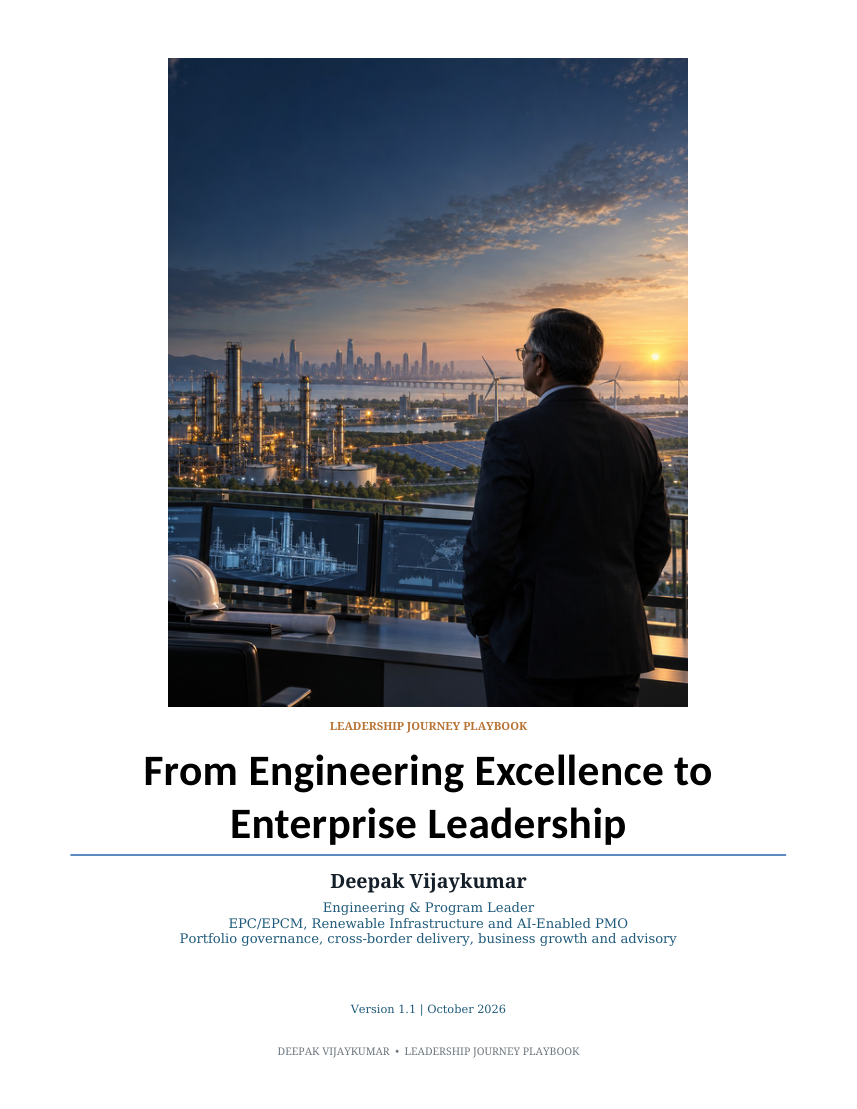
Flagship leadership booklet
Version 1.1 · October 2026
From Engineering Excellence to Enterprise Leadership—a practitioner playbook on multidisciplinary delivery, business growth, people leadership, AI-enabled PMO and research-informed performance.
View Playbook v1.1Framework case study
Published · 18 October 2026
From project data to accountable decisions: a practical operating model, measurement plan and two-page briefing. Proposed benefits await pilot validation.
Read case studyDoctoral research
Research in progress
Research in progress on hypothesised associations among leadership style, autonomy, intention to remain and perceived business performance. Findings have not yet been published.
View research designPractitioner article
Published · 1 March 2026
A perspective on how leadership systems, autonomy and the quality of work shape expert performance and retention.
Read on LinkedIn05 / Practitioner insights
Published perspectives from engineering practice. These articles are professional viewpoints, separate from my doctoral research findings.
01 / AI & engineering leadership
26 July 2026
A practitioner perspective on how AI can help leaders interpret project signals, coordinate interfaces and make timely, accountable decisions.
Read on LinkedIn02 / Program governance
Published on LinkedIn
Why the time between recognising an issue and making a decision deserves a place in engineering program reviews.
Read on LinkedIn03 / Delivery confidence
Published on LinkedIn
A leadership view of unresolved ownership, waiting dependencies and slower decisions as early signals of delivery pressure.
Read on LinkedInCareer resources
Ten interview questions and an executive answer framework, retained as a supporting resource.
06 / Speaking
Available for leadership conversations, industry panels, academic discussions and practitioner sessions.
Building exceptional multidisciplinary teams
AI-enabled engineering delivery and PMO transformation
Leadership, autonomy and talent retention
Engineering careers, consulting and organizational performance
07 / Connect
I'm interested in consequential engineering leadership, owner-side EPC and program roles, renewable energy, consulting, advisory mandates, and conversations that advance how technical organizations perform.